
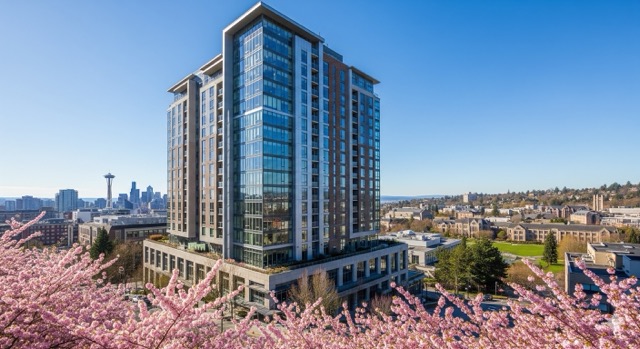
Comprehensive Analysis of Mid-Cycle Student Housing Near the University of Washington: Spring-Summer 2026 Market Dynamics
Comprehensive Analysis of Mid-Cycle Student Housing Near the University of Washington: Spring-Summer 2026 Market Dynamics
Executive Summary and Macro-Market Context
The student housing market surrounding the University of Washington (UW) in Seattle represents a highly complex, hyper-competitive real estate sector defined by a massive student population, geographical constraints shaped by surrounding waterways and steep topographies, and recent aggressive municipal zoning overhauls. Procuring high-quality accommodation for a non-standard academic period—specifically the late-Winter through Summer term bridging March 21, 2026, to August 31, 2026—introduces a unique set of structural and logistical challenges.[1] Traditional off-campus student housing portfolios are fundamentally optimized for rigid, twelve-month lease cycles that commence in September, strictly aligning with the start of the standard academic year.[1] Consequently, securing an optimal unit for a third-year undergraduate female student during a mid-cycle timeframe requires successfully navigating a highly fragmented secondary market consisting of lease transfers, specialized mid-term subletting platforms, and densely populated micro-studio developments.[2, 3]
The primary geographical focus for this demographic is the University District (commonly referred to as the U-District), a neighborhood that has undergone a radical architectural and demographic transformation following the 2017 Seattle municipal upzoning initiative.[4] This critical legislative change permitted the development of high-rise residential towers reaching up to 320 feet in specific parcels, fundamentally altering the local skyline and dramatically shifting the residential options available to the student body.[4] Prior to this rezoning, the local market was largely dominated by aging, low-rise apartment stock and informally subdivided single-family homes. Today, the landscape is stratified into three distinct architectural typologies: luxury Purpose-Built Student Accommodation (PBSA) high-rises, hyper-dense micro-studios, and traditional mid-rise multi-family apartments or private condominiums.[4, 5, 6]
This exhaustive research report delivers a meticulous analysis of the housing options available that strictly align with the specified criteria: a one-bedroom condominium, studio, or private bedroom with a washroom and accessible kitchen facilities (with shared kitchens being an acceptable compromise) from March 21 to August 31, 2026. By comprehensively examining real-time inventory, secondary market liquidity, spatial economics, transit integration, building amenities, and complex leasing mechanics, this document serves as a definitive strategic guide for residential procurement in the UW precinct.
The Structural Mechanics of Mid-Cycle Student Leasing
The Misalignment of Academic and Real Estate Calendars
The University of Washington operates on an academic quarter system, with the Spring quarter typically commencing in late March and the Summer quarter concluding in late August. While this academic schedule perfectly matches the required housing timeline spanning March 21 to August 31, the local commercial real estate market operates almost exclusively on an Autumn-centric leasing schedule.[1] Major institutional property management firms structure their debt servicing, tenant turnover, deep cleaning, and preventative maintenance schedules around a massive September move-in matrix.[1]
The direct consequence of this structural friction is that primary market liquidity in the month of March is historically low. Property managers generally only have direct inventory available if a previous tenant defaulted on their financial obligations, broke their lease prematurely due to extreme circumstances, or if a newly constructed building is in the final phases of a staggered, multi-month lease-up period.[7, 8] Therefore, prospective mid-cycle tenants attempting to secure housing directly through a leasing office face severely constrained options and often encounter premium pricing to offset the landlord’s risk of a subsequent short-term vacancy.[1, 9] Consequently, the search strategy must pivot heavily toward the secondary lease-transfer market.
Institutional and University-Managed Constraints
While the University of Washington’s Housing & Food Services (HFS) department manages a vast and diverse portfolio of on-campus residence halls and apartments, this infrastructure is largely incompatible with a late-March arrival for a non-traditional lease length.[10] HFS does operate a comprehensive Summer Intern Housing program and a Guest Housing program utilized by visiting scholars, interns, and non-matriculated students; however, this infrastructure is explicitly operational only from mid-June through late August.[10]
For the 2026 season, the earliest permitted move-in date for the UW Guest Summer Housing program is Sunday, June 21, 2026.[10] Rates for these university-managed summer studios—particularly those located in the modern Mercer Court complex on the west campus—are highly competitive at $97.25 per night, offering fully furnished spaces equipped with kitchenettes and private en-suite baths.[10] Standard single-occupancy residence hall rooms with private baths run slightly lower at $73.00 per night, or $113.50 per night for a long-term guest room stay.[10] Unfortunately, the absolute unavailability of these units during the months of March, April, and May completely removes them from consideration for the required timeline, mandating that the search be entirely restricted to the off-campus private sector.[10] Furthermore, standard undergraduate 9-month and 12-month housing applications are processed on a rigid priority system beginning in May for the following Autumn quarter, offering no mechanism for a targeted Spring quarter move-in.[10]
The Proliferation and Institutionalization of the Secondary Sublet Market
Because university students frequently secure internships in other major metropolitan areas, participate in international study-abroad programs, or graduate early at the end of the Winter quarter, a robust shadow market of lease transfers and sublets consistently emerges in the Spring and Summer months.[11, 12] This secondary market is primarily facilitated through decentralized digital infrastructure, including dedicated community subreddits such as r/udub and r/seattlehousing, extensive Facebook community groups specifically tailored to UW housing, and a growing array of specialized third-party housing platforms.[13, 14, 15]
Historically, navigating these peer-to-peer networks carried a significant risk of asymmetric information, misrepresentation of property conditions, and outright financial fraud.[11] The risk of a student transferring funds to a malicious actor posing as a departing tenant is a persistent threat in the Seattle ecosystem.[11] However, the institutionalization of the sublet market has accelerated rapidly with the advent of verified platforms like RotatingRoom and Ohana Housing Co..[2, 3]
RotatingRoom, a platform originally engineered specifically for medical professionals, travel nurses, and medical students rotating through local facilities like the UW Medical Center and Seattle Children’s Hospital, has expanded its mid-term housing footprint to accommodate university students needing standardized, furnished, short-term rentals.[3] Similarly, Ohana Housing Co. has established itself as an official housing partner that actively mitigates transaction risk.[16] Ohana mandates rigorous ID-verification for all hosts, facilitates mandatory 10-minute introductory video calls to assess roommate compatibility and tour the space, and securely holds funds in escrow until the incoming tenant explicitly confirms a successful move-in.[16] These verification layers fundamentally de-risk the transaction, which is particularly vital for parents attempting to secure housing for their undergraduate dependents from afar.[16] Ohana processes payments through secure gateways, though users must account for standard Stripe processing fees (2.9% plus $0.30 for credit cards, or a 0.8% ACH fee capped at $5).[9, 16]
Market Economics and Geographic Commuter Dynamics
Before analyzing specific architectural typologies, it is imperative to contextualize the broader Seattle rental market and the geographical realities of commuting to the University of Washington campus.
Seattle Market Averages vs. U-District Premiums
The broader Seattle housing market is characterized by high demand and substantial rental rates. Market data indicates that the average studio apartment in Seattle spans approximately 404 square feet and commands an average monthly rent of $1,409 to $1,487.[17, 18] Moving up to a standard one-bedroom apartment increases the average square footage to 650 square feet, with average rents escalating to between $2,026 and $2,079 per month.[17, 18] Two-bedroom units average 943 square feet and command $2,783 to $2,794 per month.[17, 18]
However, housing located immediately adjacent to the university operates on a localized economic model where proximity to the campus core generates a massive price premium. In the U-District, square footage is frequently sacrificed in exchange for location, resulting in the proliferation of micro-studios that offer 49% less space than the Seattle average but demand exceptionally high prices per square foot.[17]
The following table provides a comparative breakdown of the average rental metrics across the broader Seattle market to serve as a baseline for evaluating the specific U-District properties.
| Unit Typology | Average Seattle Sq. Ft. | Average Seattle Rent | Est. Price Per Sq. Ft. |
|---|---|---|---|
| Studio | 404 sq ft | $1,409 – $1,487 / mo | $3.48 – $3.68 |
| One Bedroom | 650 sq ft | $2,026 – $2,079 / mo | $3.11 – $3.19 |
| Two Bedroom | 943 sq ft | $2,783 – $2,794 / mo | $2.95 – $2.96 |
| Three Bedroom | 1,219 sq ft | $3,390 – $3,806 / mo | $2.78 – $3.12 |
| Four Bedroom | 1,244 sq ft | $3,104 – $3,475 / mo | $2.49 – $2.79 |
Geographical Profiling and Transit Integration
The University of Washington campus is geographically expansive, and the term “proximity” is a highly subjective metric depending entirely on the specific faculty building a student frequents. The topography of Seattle, characterized by steep inclines, heavy rainfall during the Spring months, and extensive waterways, heavily dictates the viability of walking commutes. According to the University of Washington’s institutional transportation survey, 79% of UW students utilize public transit to commute to school, making up 61% of the school’s 312,000 weekly commute trips.[4] Furthermore, 59% of the 47,000-person student body lives over a mile from campus, and 29% live over five miles away, highlighting that reliance on transportation infrastructure is the statistical norm.[4]
The epicenter of off-campus student life is concentrated along University Way NE (colloquially known as “The Ave”) and the immediately adjacent avenues ranging from 15th Ave NE to 8th Ave NE.[1, 19] This micro-neighborhood boasts a WalkScore of 82, classifying it as “Very Walkable,” meaning the vast majority of daily errands, grocery shopping, and social activities do not require a personal vehicle.[18] The BikeScore stands at an impressive 78, while the baseline TransitScore is rated at 64.[18]
Properties located in this immediate western core, such as The Accolade (located on 12th Ave NE), Cantor Studios (located on 18th Ave NE), and Hub U District (located on University Way NE), offer unparalleled pedestrian access.[1, 9, 20] The Accolade, for instance, is situated just 0.22 miles from the NE Campus Parkway bus station, representing a mere 3-minute walk to the western edge of the UW campus and a 5-minute walk to the crucial U-District Light Rail Station.[7, 21] Similarly, Cantor Studios positions residents just a 5-minute walk from the north campus boundary and approximately 11 minutes (0.5 miles) from the UW Law School.[9]
As students are gradually priced out of the immediate U-District core, residential development has pushed northward into the adjacent Roosevelt neighborhood.[22, 23] Buildings such as Novo Apartments (located at 6105 Roosevelt Way NE) sit approximately 1.38 to 1.65 miles from the campus center, which translates to a 27- to 30-minute walk to Red Square or the Husky Union Building (HUB).[24, 25] While a 30-minute walk may be deemed prohibitive during the inclement weather common in Seattle’s early Spring, Roosevelt’s viability has been entirely revolutionized by the expansion of the Link Light Rail network. The Roosevelt Light Rail Station provides a direct, subterranean transit link to the U-District Station, effectively reducing the commute from a 30-minute walk to a 2-minute train ride.[20, 26] Furthermore, the light rail network seamlessly connects students to downtown Seattle, Capitol Hill, and provides a direct 29-minute transit journey to the Seattle-Tacoma International Airport.[20, 27]
The following distance matrix illustrates the precise walking parameters from the major housing clusters to critical campus landmarks, demonstrating the value of geographic positioning.
| Property Location / Node | Distance to UW Red Square | Distance to Husky Union Building (HUB) | Distance to UW Medical Center |
|---|---|---|---|
| U-District Core (e.g., 4742 20th Ave NE) | 0.8 miles (16 min walk) | 0.7 miles (14 min walk) | 1.2 miles (23 min walk) |
| Northern U-District (e.g., 4754 18th Ave NE) | 0.7 miles (14 min walk) | 0.8 miles (15 min walk) | 1.1 miles (22 min walk) |
| Roosevelt Neighborhood (e.g., Novo Apts) | 1.5 miles (30 min walk) | 1.7 miles (32 min walk) | 1.8 miles (35 min walk) |
| Roosevelt Border (e.g., 6404 9th Ave NE) | 1.7 miles (33 min walk) | 1.8 miles (35 min walk) | 1.88 miles (38 min walk) |
Architectural Typologies and Specific Property Analysis
The off-campus residential market surrounding the UW campus can be explicitly classified into three primary architectural and economic tranches. Each typology offers a distinct value proposition regarding total square footage, privacy layers, amenity access, and financial cost.
Typology 1: Purpose-Built Student Accommodation (PBSA) High-Rises
The 2017 upzoning of the U-District catalyzed an unprecedented “amenity arms race” among institutional developers aiming to capture the affluent commuter and out-of-state student demographic.[4] Buildings such as The Accolade, The Standard, The M Seattle, and Hub U District represent the pinnacle of this developmental category.[1, 4, 8, 28]
These high-rise structures operate on a fractionalized leasing model, where units are leased strictly “by the bed” rather than by the total apartment.[1, 4] This individual liability structure ensures that a tenant is only financially responsible for their specific bedroom and their proportionate share of the common areas, completely immunizing them against a roommate’s potential rent default.[1] This structure is particularly advantageous for a third-year student entering a sublet scenario, as they assume no financial risk for the existing tenants.
Architectural Profile and Amenities:
PBSA developments routinely allocate a disproportionately high percentage of their gross square footage to communal amenities to foster a highly curated, immersive student community.[4] For example, The Accolade—a towering 21-story, 240-foot structure housing 226 units and 597 beds—dedicates approximately 5% of its total development area specifically to amenities, a stark contrast to the 3% average seen in standard luxury high-rises in other Seattle districts.[4] These facilities frequently include rooftop rock gardens, outdoor rock climbing walls, 26th-floor sky-deck fitness centers, group study pods with printers, and expansive multimedia lounges equipped with 55-inch flat-panel TVs and fire pits.[1, 29, 30]
Unit interiors in these buildings are similarly optimized for the modern digital student, featuring fully furnished layouts, in-unit sound bar speakers with subwoofers, USB-integrated electrical outlets, gigabit internet per bed, and premium finishes including quartz stone countertops and stainless-steel appliances.[1, 29]
Secondary Market Availability (March to August 2026):
Because these buildings cater exclusively to the student demographic, their residents are statistically the most likely to list Spring/Summer sublets when leaving for internships or early graduation.[7, 8, 28] Current secondary market data reveals several highly compatible lease transfers that perfectly align with the March 21 timeline:
- The Accolade (4126 12th Ave NE): An exceptional lease transfer opportunity is currently listed by a female student for a private bedroom within a 3-bedroom, 2-bathroom all-female suite.[7] The availability window spans from as early as March 17 to August 31, 2026.[7] The base rent has been drastically reduced on the secondary market to $1,390 per month, plus an estimated $50 in utility costs.[7] While the bathroom is shared with one other female student, the total unit encompasses a generous 951 square feet, features a full kitchen with a full-sized refrigerator, and includes an in-unit washer and dryer.[7] The steep financial discount on this unit is notable; direct leasing of a standard 387- to 395-square-foot studio directly from The Accolade’s management commands between $2,390 and $2,505 per month.[20, 27, 31, 32] The building is highly secure with keycard access and nighttime security, making it an optimal environment for a female undergraduate.[7]
- The Standard (4220 12th Ave NE): Another female-only suite is available for a lease transfer starting in March or early Spring, continuing through August 24, 2026.[8] This listing offers a private bedroom spanning 201 square feet within a massive 1005-square-foot, 5-bedroom, 2-bathroom layout.[8] The rent is highly competitive at $979 per month, with utilities fluctuating between $30 and $90 (averaging $60).[8] The apartment is fully furnished, enforces a strict no-smoking and no-pets policy, and sits a 6-minute walk from the light rail.[8] While economically advantageous, the higher roommate density (five individuals sharing two bathrooms) may introduce scheduling friction compared to a smaller suite.
- The M Seattle (4700 Brooklyn Ave NE): For maximum privacy within the PBSA sector, a prime lease transfer is available for a private bedroom and a private en-suite bathroom within a 2-bedroom, 2-bathroom unit located on the premium 20th floor.[28, 30, 33] The rent is firmly set at $1,855 per month, with approximately $60 in monthly amenity fees.[28, 30] A significant financial incentive is that the current tenant has already paid the March rent in full, offering a substantial upfront concession.[28, 30] This unit provides unobstructed high-rise views, absolute bathroom privacy, and immediate proximity to the U-District light rail station.[28, 30] The lease runs securely through August 31.[30]
Typology 2: Hyper-Dense Micro-Studios
In direct response to the broader housing affordability crisis and the extreme premium placed on geographic proximity to the UW campus, developers have aggressively introduced micro-studios into the U-District ecosystem.[9, 34] Property management firms like Tripalink specialize almost exclusively in this high-density asset class, managing buildings such as Cantor Studios, Juno Studios, Sophie Studios, and Alta Studios.[5, 9, 34, 35]
Architectural Profile and Economics:
Micro-studios fundamentally challenge traditional residential spatial economics. Ranging from a microscopic 140 square feet to approximately 180 square feet, these units are engineered exclusively for high-turnover student occupancy.[5, 9, 34] To accurately contextualize this density, the average micro-studio provides 49% less total square footage than a traditional Seattle studio apartment.[17] Consequently, the price per square foot is exceptionally high—frequently exceeding $6.10 per square foot—even though the absolute gross rent remains accessible to students, typically ranging from $849 to $1,250 per month.[9, 17, 34]
To compensate for the severe spatial constraints, micro-studios employ hyper-efficient, modular interior design. A standard unit at Cantor Studios (spanning 150 to 165 square feet) or Juno Studios (spanning 175 to 180 square feet) features a Twin XL bed, a built-in study desk with a chair, and a simplified kitchenette equipped solely with a microwave, a mini-refrigerator, and occasionally a portable induction hot plate.[9, 34] Full culinary preparation requires residents to utilize a much larger, fully equipped shared community kitchen located elsewhere in the building.[9, 34] This architectural decision perfectly aligns with the original request, which explicitly stated that a shared kitchen is an acceptable parameter. While some micro-studios offer completely private en-suite bathrooms with stand-up showers, others operate on a Single Room Occupancy (SRO) model with shared hallway washrooms; therefore, tenants must meticulously verify the specific floor plan before signing a lease.[9, 34]
Relevance and Procurement Mechanics:
For a third-year undergraduate, micro-studios offer the distinct advantage of living without roommates while maintaining immediate walking access to campus classes.[5, 9, 34] To secure a unit within the Tripalink portfolio, applicants must pay a $50 non-refundable application fee and pass a rigorous background and credit check requiring a minimum credit score of 675.[9] If the student lacks this credit history, a co-signer with a US-based address and a credit score exceeding 680 to 700 is mandatory.[9] Move-in capital requirements generally include the first month’s rent, the last month’s rent, and a security deposit equivalent to one month’s rent.[9]
The primary risk associated with this typology is inventory availability. Attempting to secure a customized 5-month short-term lease starting precisely in March directly from the property manager may incur heavy premium pricing or face outright rejection if the building favors maintaining availability for the lucrative September cycle.[9, 34] However, the lower baseline rent makes this a highly viable fallback option.
Typology 3: Traditional Multi-Family Apartments and Condominiums
The third residential sector comprises standard multi-family mid-rise apartments and privately owned condominiums. These units reflect traditional urban housing parameters, offering substantially more space and full-sized private kitchens, but at a higher gross cost and typically situated further from the pedestrian campus core.
Architectural Profile and Demographics:
Traditional one-bedroom condominiums in the U-District provide an average of 600 to 750 square feet of living space.[6] Unlike the PBSA developments that conveniently bundle utilities, high-speed internet, and modern furnishings into the single rental installment, traditional condos are generally leased completely unfurnished.[6, 36] Incoming tenants are entirely responsible for independently establishing utility accounts with Seattle City Light and local internet providers. The demographic in these buildings is a broad mix of graduate students, university faculty, and young working professionals, resulting in a quieter, less transient environment compared to the undergraduate-heavy high-rises.
Secondary Market Availability (March to August 2026):
Securing a traditional condo or apartment for an off-cycle, five-month period is structurally the most difficult path. Most independent landlords and condominium associations mandate strict 12-month leases to minimize expensive turnover costs and vacancy risks. However, specific anomalies exist in the current market data:
- Novo Apartments (6105 Roosevelt Way NE): Located slightly north of the U-District in the transit-rich Roosevelt neighborhood, Novo Apartments bridges the gap between traditional apartments and student housing. The building offers traditional studio layouts ranging from 160 to 347 square feet.[22] A current tenant is attempting to facilitate a lease transfer for an unfurnished, approximately 200-square-foot studio featuring a private bath.[2, 37] The transfer window is incredibly flexible, available from March 1 to September 25, 2026, perfectly enveloping the required timeframe.[2, 37] The rent is highly attractive, listed between $1,053 and $1,275 per month.[2, 37] While the unit is unfurnished, the departing tenant has offered an air mattress to bridge the gap, though securing basic furniture for five months will represent an additional logistical hurdle.[37] The location provides a direct 2-minute light rail commute to the UW campus, offsetting the 1.38-mile distance.[24, 25]
- Private Condominium (4547 8th Ave NE #602): A top-floor, 610-square-foot, one-bedroom condominium is currently listed on the primary market for $2,300 per month.[6] This unit represents the highest tier of independent living, featuring high ceilings, central air conditioning (a significant rarity in older Seattle residential buildings), and an in-unit washer and dryer.[6] While this offers absolute privacy and substantial space, the primary obstacles will be negotiating a lease that terminates prematurely in August 2026, absorbing the high baseline rent, and managing the logistical nightmare of outfitting an entirely empty apartment for a mere five-month residency.
- Seattle Seamless Sublease (Ohana Platform): A verified sublet is available through the Ohana Housing network for a one-bedroom within a 2-bedroom unit.[2] The unit is move-in ready starting February 19 and runs through August 31, perfectly matching the required timeline.[2] Priced at $1,789 per month, this option offers the immense security of the Ohana verification system, ensuring the host is ID-verified and funds are held in escrow, making it one of the safest transactions available.[2, 16]
Comprehensive Tabular Synthesis of Viable Rental Listings
The following matrix synthesizes the most highly compatible listings available for the March 21 to August 31, 2026, timeframe, rigidly adhering to the requested analytical parameters. Data has been meticulously extracted from secondary market listings, institutional property portfolios, and specialized housing networks. Note that to address the redundancy in the requested prompt headers (“rent, space area, rent”), the table categorizes the financial obligations into “Rent (Base)” representing the advertised lease rate, and “Rent (Total)” which estimates the gross monthly expenditure inclusive of mandatory utilities or specific amenity fees explicitly stated in the listings.
| Address | Rent (Base) | Space Area | Rent (Total) | Bedroom | Bathroom | Distance to UW | URL (link to the post) | Remarks |
|---|---|---|---|---|---|---|---|---|
| The M Seattle 4700 Brooklyn Ave NE |
$1,855/mo | ~632 sq ft (Total Unit) | $1,915/mo | 1 (in 2-bed suite) | 1 (Private) | U-District Core (Close to Light Rail) | Link | Optimal Privacy. Private bed and private en-suite bath. March rent is fully paid by the current tenant, offering massive upfront savings. High-rise luxury amenities; sublet runs through Aug 31. [28, 30] |
| The Accolade 4126 12th Ave NE |
$1,390/mo | 951 sq ft (Total Unit) | $1,440/mo | 1 (in 3-bed suite) | 1 (Shared with 1 person) | 0.6 miles (3 min walk) | Link | Optimal Security. All-female unit. Massive discount from standard $2,400+ rates. Fully furnished. Move-in available as early as March 17 through Aug 31. Shared washroom is the only compromise. [7] |
| Seattle Seamless U-District (Ohana) |
$1,789/mo | Unspecified | $1,789/mo | 1 (in 2-bed suite) | 1 (Private) | Near UW | Link | Vetted Platform. ID-verified sublet via Ohana. Move-in ready Feb 19 – Aug 31. Escrow payment system prevents fraud. Exact address provided upon matching. [2] |
| Novo Apartments 6105 Roosevelt Way NE |
~$1,053/mo | ~200 sq ft (Studio) | ~$1,053/mo + Utilities | Studio | 1 (Private) | 1.38 miles (2 min via Light Rail) | Link | Independent Living. Lease transfer available March 1 to Sep 25. Studio with private bath. Excellent access to Roosevelt Light Rail station. Unit is unfurnished. [2, 37] |
| The Standard 4220 12th Ave NE |
$979/mo | 201 sq ft (Room) / 1005 sq ft (Total) | ~$1,040/mo | 1 (in 5-bed suite) | 1 (Shared) | 12 min walk | Link | Budget Sublet. All-girls apartment. Fully furnished. High density (5 roommates sharing 2 bathrooms). Available March to August 24. [8] |
| Cantor Studios 4754 18th Ave NE |
$999 – $1,250/mo | 150 – 165 sq ft (Micro-Studio) | Varies | Studio | 1 (Private) | 0.5 miles (11 min walk) | Link | Micro-Living. Fully furnished micro-studio with private bathroom. Unit has a kitchenette; access to larger community kitchen. Tight square footage. Subject to primary market availability. [9] |
| Juno Studios 4742 20th Ave NE |
$899 – $1,175/mo | 175 – 180 sq ft (Micro-Studio) | Varies | Studio | 1 (Private or Shared) | 0.5 miles (12 min walk) | Link | Micro-Living. Similar to Cantor. Fully furnished. Twin XL beds. Must specify desire for private washroom floor plan when inquiring. Subject to primary market availability. [34] |
| Private Condominium 4547 8th Ave NE #602 |
$2,300/mo | 610 sq ft | $2,300/mo + Utilities | 1 | 1 (Private) | U-District Core | Link | Traditional Condo. Top floor unit with high ceilings, A/C, and in-unit laundry. Expensive and likely requires negotiating a non-standard 5-month lease term. Unfurnished. [6] |
Strategic Conclusions and Procurement Recommendations
The micro-economics of the University of Washington housing market heavily penalize deviations from the standard September leasing cycle. However, the robust secondary market born out of student transiency provides exceptional opportunities for strategic procurement if one is willing to rigorously navigate the lease transfer process.
For a third-year female undergraduate requiring secure, convenient housing from March 21 to August 31, 2026, the data clearly isolates two optimal strategic pathways that balance safety, spatial comfort, and financial efficiency:
Pathway 1: The Premium PBSA Sublet (The M Seattle / The Accolade)
Capitalizing on the desperation of students needing to offload their leases mid-year is the most economically advantageous strategy. The sublet at The M Seattle ($1,855/month) perfectly encapsulates the specified criteria: it offers a private bedroom, a private en-suite washroom, shared access to a full kitchen, and resides within a luxury high-rise featuring elite security and amenity infrastructure.[28, 30] The immense financial concession of a fully paid March rent significantly amortizes the overall cost of the 5.5-month stay.[28]
Alternatively, the sublet at The Accolade ($1,390/month) offers a dramatic reduction in base rent within a highly desirable all-female suite.[7] While it requires compromising on a shared washroom, the presence of an in-unit washer and dryer, full furnishings, and keycard security make it an incredibly secure and comfortable environment for a female student.[7] Both options provide fully furnished living spaces, negating the logistical nightmare and financial burden of purchasing and moving furniture for a short-term academic stint.
Pathway 2: Verified Escrow Platforms and Independent Micro-Studios
If cohabitation is fundamentally unacceptable or the Reddit-based sublets are already claimed, utilizing verified networks or the micro-studio market is the definitive fallback. The Seattle Seamless option managed by Ohana ($1,789/month) offers the peace of mind of ID verification and escrow payments, significantly reducing the anxiety of a remote real estate transaction.[2, 16]
If complete independence is required, securing a unit at Cantor Studios or Juno Studios guarantees a private washroom and kitchenette within a highly efficient 150- to 180-square-foot footprint for approximately $1,000 to $1,250 per month.[9, 34] While spatially restrictive, these properties are heavily concentrated within a 12-minute walk of the core campus and provide access to the larger community kitchens, fulfilling the requested criteria.[34] The lease transfer at Novo Apartments (~$1,053/month) offers slightly more space and seamless integration into the Roosevelt Light Rail node, making it an exceptional compromise between privacy, financial cost, and transit connectivity.[24, 25, 37]
When finalizing any secondary market transaction, utilizing institutional lease-transfer mechanisms (working directly through the leasing office of buildings like The Accolade) or utilizing vetted escrow platforms like Ohana Housing Co. is strictly advised to mitigate the severe risk of digital marketplace fraud.[11, 16] By executing a lease transfer in a PBSA high-rise or utilizing a verified network, the student will secure a highly amenitized, secure, and geographically optimized residential experience for the entirety of the Spring and Summer academic quarters.